

Published January 12, 2024 · Updated September 15, 2026
Google Sites is a simple website builder from Google that lets you create and publish a website without coding. It is easy to use, integrates closely with Google Workspace tools, and can be a good option for internal resources, project hubs and simple information sites.
But is Google Sites a good choice for your business website? If your website needs to generate leads, compete in search and support long-term growth, a more flexible approach to professional website design will usually give you considerably more control.
For some businesses and organizations, Google Sites can still be a perfectly reasonable choice. Here’s what it does well, where it falls short and how to decide whether it’s right for you.
What Is Google Sites?
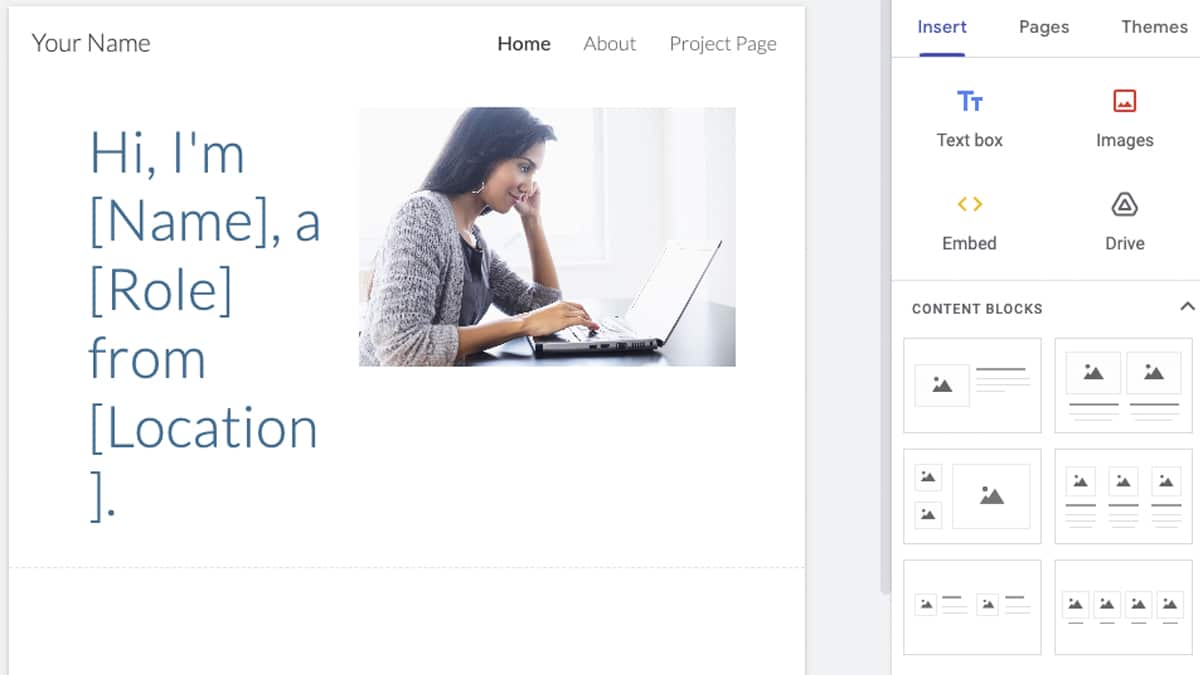
Google Sites is Google’s drag-and-drop website-building platform. You can start with a blank site or one of Google’s templates, add pages and navigation, and publish the finished site without managing separate website hosting.
The editor is intentionally simple. You can add text, images, buttons, image carousels and other basic page elements. It also integrates especially well with Google tools such as Docs, Sheets, Slides, Forms, Maps, Calendars and YouTube.
That makes Google Sites particularly useful when the website is really an extension of Google Workspace rather than a full marketing platform.
Is Google Sites Free?
Google Sites has a very low barrier to entry because you do not need to purchase separate website hosting just to create and publish a basic site.
Businesses using Google Workspace can also use Google Sites as part of their existing Google ecosystem.
You can connect a custom domain so visitors see an address such as www.yourbusiness.com instead of a Google Sites URL.
For simple projects, that combination of low cost and ease of use is one of the platform’s biggest advantages.
What Can You Build With Google Sites?
Google Sites works particularly well for simple websites where ease of use matters more than advanced marketing functionality.
Internal Team or Project Hubs
This is arguably where Google Sites is strongest.
You can build a central resource for your team and bring together Google Docs, Sheets, Slides, Forms, Calendars and other Workspace content in one place.
For an internal company portal, onboarding resource or project dashboard, that can be extremely useful.
Event or Information Websites
If you simply need a few pages explaining an event, program, club or initiative, Google Sites can work well.
You can add navigation, images, buttons, maps and basic content without needing to maintain a more complicated content management system.
Customer or Member Resource Portals
Google Sites can also work as a simple resource centre where customers, members or other audiences can access documents, instructions, forms and useful links.
Personal or Temporary Websites
For a portfolio, classroom project, community initiative or short-term website, simplicity may be more important than advanced features.
In those situations, Google Sites can be a practical option.
What Are the Advantages of Google Sites?
It Is Easy to Use
You do not need to know HTML, CSS or WordPress.
Google Sites uses a straightforward visual editor, and most people who are already comfortable with Google products can learn the basics quickly.
It Integrates Extremely Well With Google Workspace
This is probably the platform’s biggest advantage.
Google Sites makes it easy to bring content from Google Drive, Docs, Sheets, Slides, Forms, Maps, Calendars and YouTube into your pages.
For an organization already operating heavily inside Google Workspace, that can make Google Sites particularly convenient.
Google Handles the Hosting
You do not have to install software, manage a server or deal with the normal updates associated with a full content management system.
That simplicity is appealing if the website itself is not a major part of your marketing strategy.
You Can Customize the Look
Google Sites gives you control over things such as themes, colours, fonts, logos, backgrounds and navigation.
There is enough flexibility to make a simple website feel reasonably branded.
However, the level of customization is still much more limited than what you can achieve with a full website platform.
You Can Track Website Traffic
Google Sites can be connected to Google Analytics, allowing you to measure website traffic and basic visitor behaviour.
What Are the Limitations of Google Sites?
The same simplicity that makes Google Sites attractive can eventually become its biggest limitation.
For a business website, that distinction matters.
Limited Design Flexibility
You can customize the appearance of a Google Site, but you are still working within Google’s layout system.
If your website needs to closely reflect an established brand, use highly customized layouts, create advanced interactions or support unusual functionality, you can run into the platform’s limits fairly quickly.
A professional website should be designed around the organization, its audience and what visitors need to accomplish — rather than forcing everything into whichever layouts the platform happens to provide.
Limited SEO Control
A public Google Site can appear in Google Search.
The bigger issue is the amount of control you have over your website as your SEO strategy becomes more sophisticated.
Search engine optimization involves much more than simply getting a page indexed. Site architecture, content, internal linking, page structure, performance, local relevance and the ability to continually improve the site all matter.
For a basic information website, Google Sites may give you enough.
For a business competing for valuable searches in a crowded market, I would generally want more flexibility.
That is especially important if SEO and digital marketing are expected to become meaningful sources of new business.
It Is Not a True Blogging Platform
You can create new pages in Google Sites and use them like articles, but Google Sites is not a traditional blogging platform.
If you plan to publish a large amount of content, the difference becomes significant.
A full content management system makes it much easier to manage articles, categories, authors, archives, internal links and an ongoing publishing strategy.
For a company using content to build organic visibility, managing dozens or eventually hundreds of resources manually can become cumbersome.
No Traditional Plugin Ecosystem
One of the advantages of platforms such as WordPress is the ability to extend the website as your needs change.
Forms, e-commerce, events, directories, memberships, SEO tools, CRM integrations and other functionality can be added without rebuilding the entire website.
Google Sites is intentionally much simpler.
You can embed external tools and content, but it does not provide the same kind of extensible website ecosystem.
Limited E-Commerce Capability
Google Sites would not be my first choice for a serious online store.
If you need product management, inventory, checkout, payment processing, shipping functionality and sophisticated e-commerce marketing, you are usually better served by a platform designed for those requirements.
You can connect or embed third-party tools, but eventually you may find yourself working around the platform rather than with it.
Can You Use Google Sites for a Business Website?
Yes.
The more important question is whether you should.
If your organization simply needs a few pages explaining who you are, what you do and how to contact you, Google Sites may be perfectly adequate.
But the answer changes if your website is expected to:
- generate leads
- rank competitively in Google
- support regular content publishing
- integrate with your marketing
- handle e-commerce
- support complex functionality
- grow significantly over time
- provide a highly customized visitor experience
For many established businesses and organizations, the website eventually becomes too important to treat as a basic online brochure.
That is something we see locally as well. Our Kitchener-Waterloo Website Study analyzed 100 local business websites across 1,700 individual data points and found that simply having the technical basics in place does not necessarily mean a website is doing a good job of supporting the business.
Is Google Sites Good for SEO?
Google Sites can appear in Google Search, so using Google Sites does not automatically mean your website cannot rank.
But there is an important difference between being indexable and having a platform that gives you the flexibility to execute a competitive SEO strategy.
Good SEO involves your site structure, page content, internal linking, technical setup, authority, local signals, user experience and ongoing optimization.
For a small informational website where Google Search is not particularly important, the limitations may never matter.
If organic search is expected to generate leads and revenue, I would generally choose a platform that gives you greater control over those elements.
Can You Blog With Google Sites?
Technically, yes.
You can create individual pages and publish them as articles.
But if publishing content is going to become an important part of your marketing, I would not choose Google Sites specifically for that purpose.
A real content management system makes it considerably easier to organize, update and interlink a growing library of useful content.
That becomes increasingly important when your articles are supporting service pages, answering customer questions and helping build your visibility in search.
Is Google Sites Better Than WordPress?
It depends on what you are trying to accomplish.
Google Sites is simpler.
WordPress is much more flexible.
If you need an internal portal, small resource site or basic information website, Google Sites may actually be the better choice. There is less to configure, less to maintain and less opportunity to overcomplicate the project.
If you are building a serious business website intended to support SEO, marketing, lead generation and future growth, WordPress will generally give you much more control.
That flexibility is one of the reasons we use WordPress for many of our website design projects. It allows us to choose the structure, functionality and design around what the business or organization actually needs rather than designing around the limitations of the website builder.
Who Should Use Google Sites?
Google Sites can be a good fit for:
- internal company portals
- employee resources
- project hubs
- community groups
- educational resources
- temporary websites
- event websites
- simple informational websites
- organizations already heavily invested in Google Workspace
For those uses, it can be an excellent tool.
Who Should Probably Use Something Else?
I would seriously consider another platform if you are:
- an established business or nonprofit
- relying on Google Search to generate leads
- planning an ongoing content strategy
- running an online store
- investing substantially in digital marketing
- building complex forms or integrations
- expecting your website to evolve significantly
- competing in a crowded local or industry market
In those situations, choosing the easiest platform today can sometimes mean rebuilding the website later.
So, Should You Use Google Sites?
Google Sites is a good tool when you use it for the right job.
It is simple, easy to manage and particularly useful for bringing Google Workspace information together in one place.
For an internal resource, temporary website or straightforward information site, that may be exactly what you need.
But I would not choose a website platform simply because it is free or easy to get started.
If your website is going to play an important role in how customers find you, evaluate your organization and decide whether to contact you, think beyond the initial build.
You need a website that can support where the organization is going, not just where it is today.
If you’re deciding between Google Sites and a more complete business website, learn more about our approach to professional website design in Kitchener-Waterloo.
Already know you need something more capable? Tell us about your website project and request a quote.
