

When we build a website, we usually like to start fresh: new strategy, new structure, new design. But if you already have a site, a full rebuild isn’t your only option. A focused refresh can bring in more inquiries for less, as long as the foundation is sound.
The deciding factor shouldn’t be how dated the site looks. It should be what the site is doing for your business, and what’s stopping it from doing more. A site can look a few years old and still earn its keep, and a brand-new design can still fail to bring in a single call.
A quick note on terms. Agencies use these words loosely. Here, a refresh improves the existing site (its message, page structure, calls to action, and proof) while keeping the platform and the pages that already perform. A rebuild replaces the site with a new one. “Redesign” gets used for both, so always ask what’s actually included.
Start with the business case
A website exists to produce inquiries, bookings, or sales. Start with data, not taste: how a site looks to you is a poor guide to how it performs. Then ask three questions.
- Is the site converting? Compare visitors with calls, form submissions, and bookings over the same few months. Plenty of traffic but few inquiries usually points to the message, the page structure, or the calls to action, and a refresh can fix all three. Low traffic is a different problem, and a new design alone won’t solve it.
- Does it match the business today? If your services, audience, or pricing have changed, the site has to change with them. Otherwise it sends the wrong people your way, or sends the right ones to a competitor.
- What’s worth protecting? Pages that rank, bring in traffic, or already generate leads are assets. A rebuild can put them at risk.
If the foundation is sound but out of step with the business, refresh it. If the platform, structure, or positioning is the problem, a fresh start is the better investment.
What a rebuild puts at risk
Most people worry about cost and timing. The bigger risk is quietly losing what already works. Search engines rank individual pages at specific addresses. When a rebuild changes those addresses, drops pages, or rewrites content without a plan, the rankings and links built up over the years can disappear, and the inquiries that came with them.
Before any work starts, we check four things:
- Which pages bring in traffic and leads. These get kept, improved, or moved with care.
- Which addresses other sites link to. Changing an address breaks those links unless it’s redirected.
- How forms, phone numbers, and tracking are set up. Rebuilds often break these, and nobody notices for weeks.
- What the old pages say. Rewriting a page that ranks for a phrase can cost you that ranking.
Whichever path you take, every old address that changes should redirect to its new equivalent. A refresh makes that easier because fewer things change. A rebuild can protect your visibility too, but only if the plan exists before the first page is designed.
When a refresh makes sense
A refresh is the right call when the foundation is solid but the site no longer reflects, or sells, the business you run today. Common signs:
- Your services have changed, but the site still describes the business you were a few years ago.
- You’ve added offerings or audiences that don’t have a page of their own.
- Visitors land on the site, but few of them call, book, or send an inquiry.
- Calls to action are buried, vague, or missing.
- Photos, projects, and reviews don’t build trust.
- The site is hard to use on a phone.
If that sounds like your site, a refresh could pay off faster than a rebuild. If you’re not sure, our free Website Growth Score takes about three minutes and shows you what to fix first.
When a fresh start is the better call
Some sites can’t be fixed with a refresh. Start over when:
- Your business model, brand, or target customer has changed significantly. A new audience usually needs a new message, structure, and look, not a touch-up.
- The platform can’t support what you need. If adding a page is painful, edits need a developer, or pages stay slow on a phone, you’re fighting the foundation.
- Most of the content is out of date. If you’d rewrite nearly every page anyway, a refresh saves little.
- There’s little search visibility or traffic worth protecting. With nothing to preserve, a rebuild carries much less risk.
If that’s where you land, see our website design services.
Refresh vs. fresh start at a glance
| Factor | Refresh | Fresh start |
|---|---|---|
| Best when | The foundation is sound but the business has moved on | The platform, structure, or positioning is the problem |
| What changes | Message, page structure, calls to action, proof | Strategy, structure, design, and content |
| What stays | The platform and the pages that already rank and convert | Only what we choose to carry over |
| Timeline | Shorter, because fewer pages and systems change | Longer, because strategy, design, content, and migration all happen |
| Investment | Lower, scoped to the changes that matter | Higher, covers the whole site |
| Risk to rankings | Lower, because fewer addresses change | Higher unless a redirect and migration plan comes first |
| Needed before starting | An audit of what performs | An audit, a content inventory, and a redirect map |
Case study: Hacienda Sereda
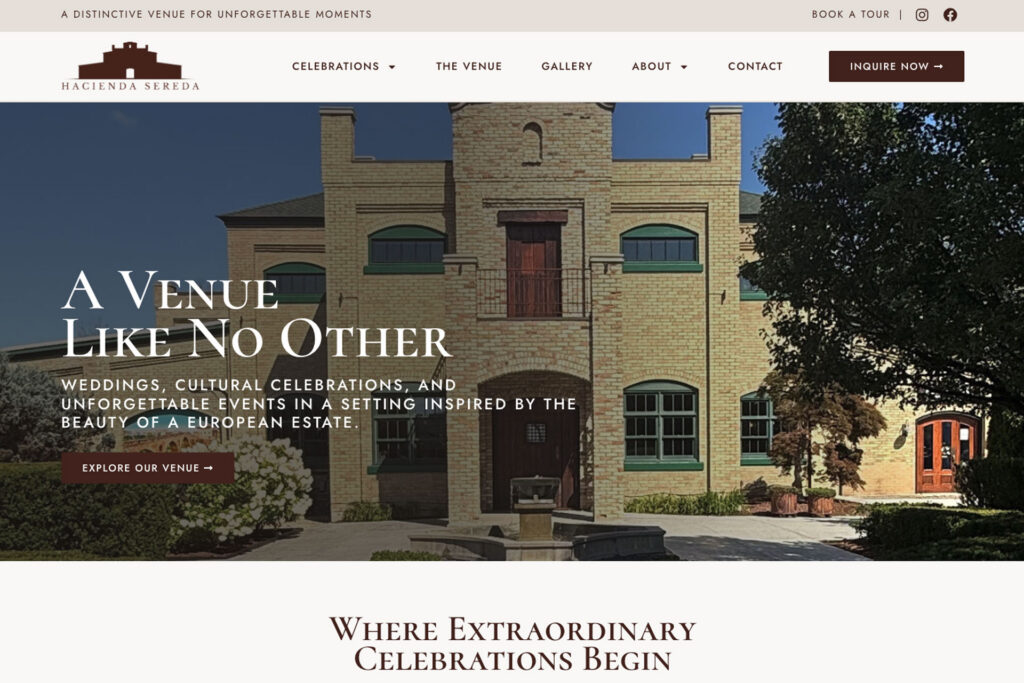
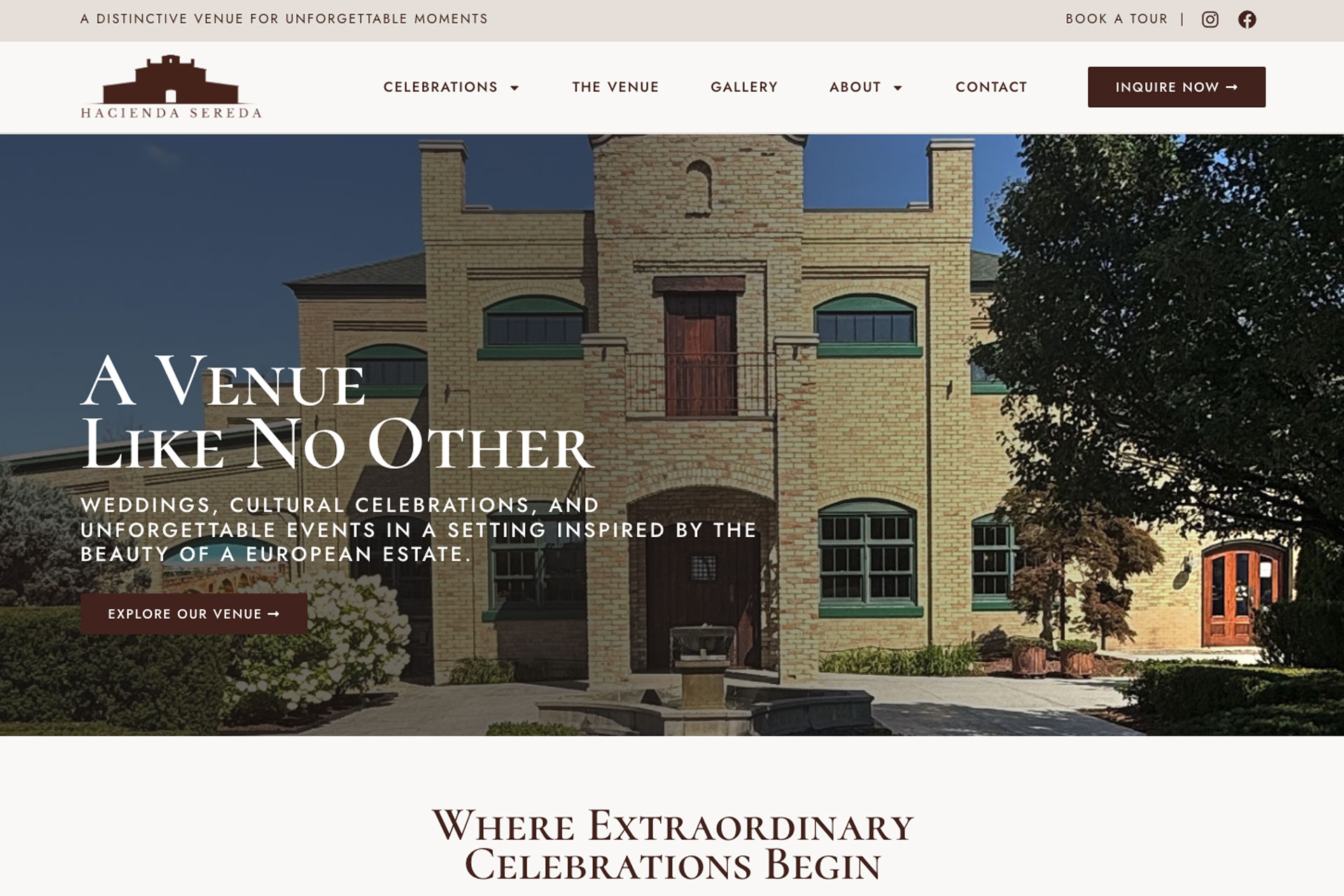
Hacienda Sereda is a Kitchener event venue with soaring arches, a glass-ceilinged courtyard, and elegant interior spaces. As an existing Evergreen client, they wanted a website that showed the property better and made it easier for people planning a celebration to take the next step.
The problem: The architecture is the venue’s biggest selling point, but photos alone don’t tell a couple whether the space fits their celebration. Weddings, South Asian receptions, Mehndi celebrations, and Nikah ceremonies each have different requirements, and one generic events page couldn’t speak to all of them.
What we changed: We redesigned the site around the venue and the celebrations it hosts.
- Photography up front. Large images and clean layouts, with room for each of the venue’s individual spaces to stand out.
- A page for each type of celebration. Dedicated pages for weddings, Mehndi celebrations, Nikah ceremonies, and South Asian wedding receptions. Visitors land on a page that matches what they’re planning, and each page targets what people actually search for.
- A clearer path to inquiry. Simpler navigation, a better mobile experience, and clear prompts to ask about availability or book a tour.
The result: A site that connects the venue’s spaces to the celebrations people are planning, and makes it easy to get in touch. Every page now answers the question a planner arrives with: can this venue host the celebration I have in mind? See the full Hacienda Sereda case study.
What a refresh looks like
Whether you’re a current Evergreen client or just starting a conversation with us, the approach is the same:
- Audit. Find which pages rank, bring traffic, and generate leads, so we know what to keep.
- Update the offer. Make the site reflect your current services, audience, and positioning.
- Fix the path to conversion. Clear calls to action, simple forms, and a site that works on mobile.
- Build pages around what customers search for. Dedicated pages for specific services or audiences.
- Strengthen proof. Better photography, projects, and reviews, placed where visitors decide whether to trust you.
Questions we hear
Will a redesign hurt my search rankings?
It can. The usual causes are changed addresses with no redirects, deleted pages that ranked, and rewritten copy on pages that ranked for a specific phrase. All three are avoidable: list your best-performing pages first, map every old address to its new one, and keep the wording that earns the ranking. Then watch your search data for the first few weeks after launch.
How long does a refresh take compared to a rebuild?
A refresh is usually quicker, because fewer pages and systems change. The biggest variables are how many pages need new content and how fast feedback and approvals come back. We give you a timeline after the audit, once we know the scope.
Can I keep my current platform?
Usually, if you can add and edit pages without a developer and pages load quickly on a phone. If you can’t do those things, that’s the strongest case for a fresh start.
How do I know if my site is converting?
Pull a few months of data: visitors, plus the number of calls, form submissions, and bookings. Divide inquiries by visitors for a rough conversion rate. If visitors are steady and inquiries are few, the site is the bottleneck. If both are low, visibility is the first problem to solve.
Do I need to decide before talking to anyone?
No. A short audit shows what’s working and what isn’t, and the answer is often clearer than people expect.
Refresh or fresh start?
Not sure which fits your business? Start with a Website Audit and we’ll show you what to keep, what to fix, and whether a fresh start would serve you better.
Or just get in touch. Tell us what you’re working on, and we’ll tell you what it needs. No pitch, no pressure.